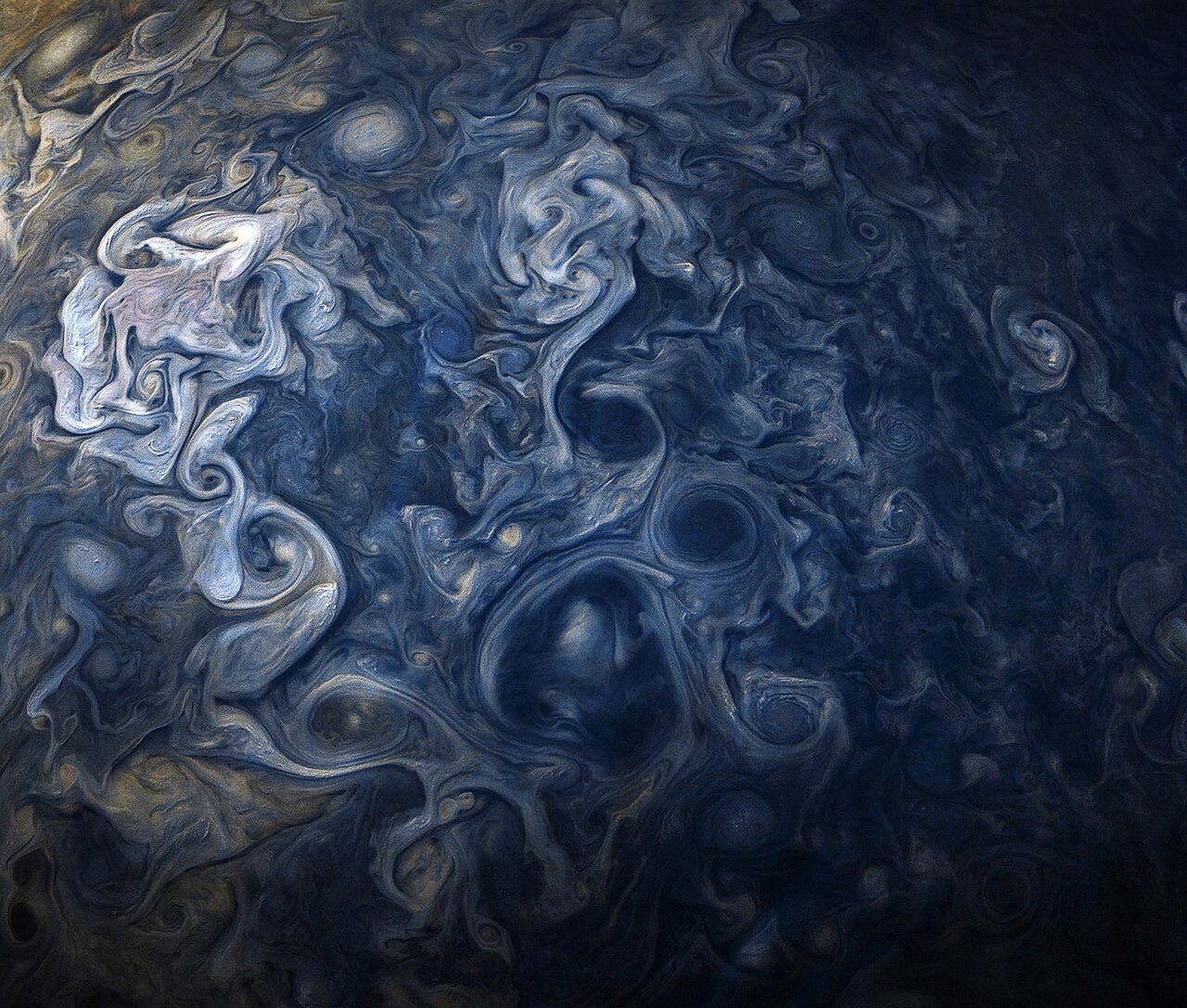
 NASA/JPL-Caltech/SwRI/MSSS/Gerald Eichstadt/Sean Doran · Public domain
Juno finds rippling waves in Jupiter's magnetic disk
NASA's Juno probe found rippling waves in Jupiter's magnetic disk.
 Evenly newsroom
Key facts
- The disk of charged gas around Jupiter bends in waves that turn with the planet.
- The ripples last from a few minutes to more than an hour.
- The study was led by researchers from Shandong University in China.
Data from NASA's Juno spacecraft show that the huge disk of charged gas around Jupiter does not stay flat but bends into ripples, scientists reported in October 2026. The study was published in the journal Science China Earth Sciences. It was led by Ruilong Guo of Shandong University in China, with scientists from the University of Liège in Belgium and the University of Hong Kong, according to Universe Magazine.
This structure is called the magnetodisk. It is a ring-shaped layer of plasma, a gas made of electrically charged particles, held by Jupiter's magnetic field. Much of the material comes from the volcanoes of Io, one of Jupiter's moons. The centre of the disk is a thin layer called the current sheet. Because Jupiter turns once in nearly 10 hours, Juno usually crosses this sheet about twice per rotation.
Scientists had thought the disk was a smooth surface that simply moves up and down as the planet turns. The new study found that, during active periods, it crumples into waves that last from a few minutes to more than an hour. On one occasion, Juno crossed the sheet four times in ten minutes. The team linked the ripples to magnetic reconnection, a process in which magnetic field lines break and join again, releasing energy. Many small reconnection sites were spread across about 100 degrees of longitude, more than a quarter of the way around the planet. Because Jupiter spins so fast, the rippled sheet is carried around with it.
Earth's magnetic field shows similar waves, but there they start from one point and travel outward. At Jupiter, the pattern is different. The researchers said the ripples may change how particles from Io are speeded up and moved around, including towards Jupiter's auroras. The reports do not say how many events were studied, and the full mechanism is not yet explained. Juno's extended mission is planned to run until September 2028.
- Where
- Jinan, China
- When
- Reported in October 2026
Sources
Image
NASA/JPL-Caltech/SwRI/MSSS/Gerald Eichstadt/Sean Doran · Public domain · Wikimedia Commons