 NASA, ESA, J. Olmsted (STScI) · CC BY 4.0
Black holes of all sizes fire jets at the same feeding rate
Black holes of all sizes seem to fire jets at the same feeding rate.
 Evenly newsroom
Key facts
- Jets switch on when a black hole feeds at about 2% of its maximum rate.
- The rule holds for small black holes and for giants millions of times heavier.
- The study looked at 10 stars torn apart by black holes.
Black holes of very different sizes appear to start their jets at the same stage of feeding, according to a study in the journal Nature Astronomy. The work was led by Andrew Mummery of the Institute for Advanced Study in Princeton, USA, and Adelle Goodwin of Curtin University in Western Australia. The institute announced the results on September 17, 2026.
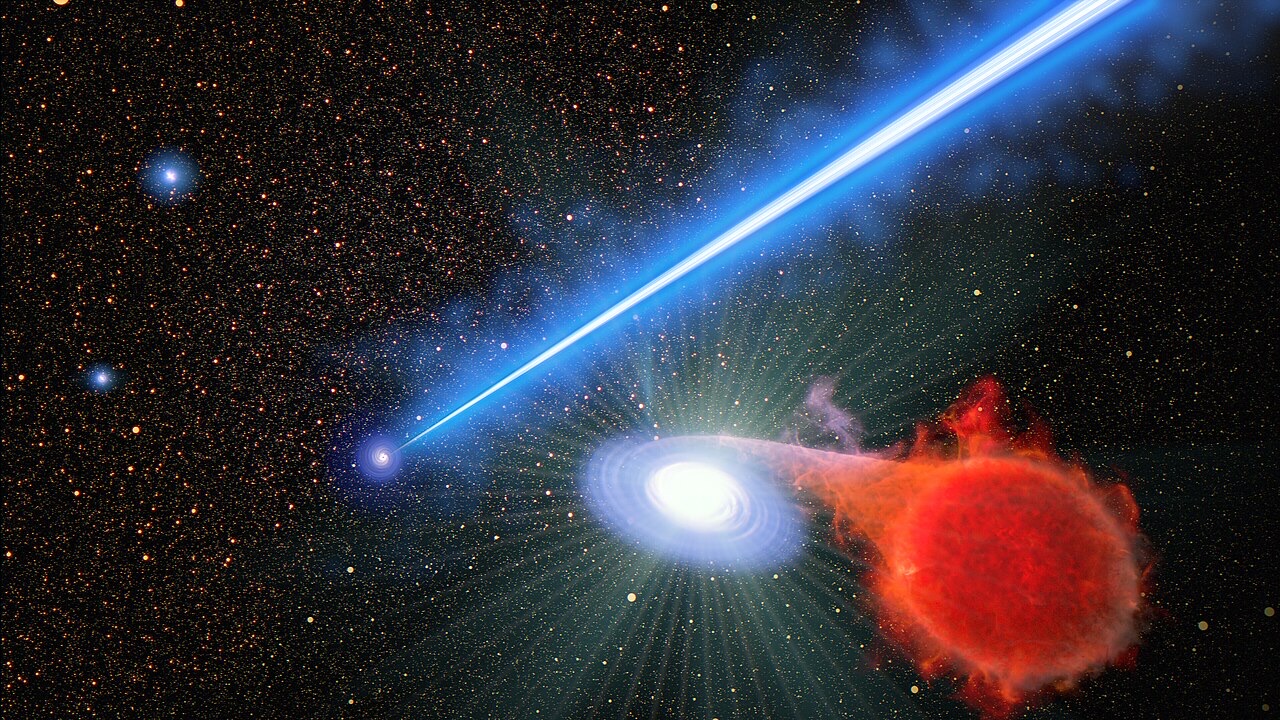
A jet is a narrow beam of matter and energy that some black holes shoot into space. The team studied tidal disruption events. These happen when a star passes too close to a giant black hole and its gravity pulls the star apart. The black hole then feeds on the gas from the star. The researchers looked at 20 such events and kept the 10 with the best data, using optical, ultraviolet, X-ray and radio observations from telescopes on several continents and in space.
They found two moments when jets can appear. The first comes soon after the star is torn apart, while the black hole is feeding very fast. The second comes hundreds to thousands of days later, when the feeding rate falls to about 2% of the Eddington limit. This limit is the point where the push of light from the hot gas balances the pull of gravity, and astronomers use it to measure how fast a black hole eats.
The same 2% level was already known to switch on jets in small black holes in our galaxy, which weigh about 10 times as much as the Sun. The new result suggests that the same rule also works for black holes millions of times heavier.
The study rests on a small sample of 10 events, because these star-shredding events are rare. The researchers said the rule could help astronomers predict when a delayed jet will appear, and plan telescope time better. This could be useful for the Square Kilometre Array radio telescope, which is expected to start collecting science data in 2028.
- Where
- Princeton, USA
- When
- Reported Sep 17, 2026
Sources
Image
NASA, ESA, J. Olmsted (STScI) · CC BY 4.0 · Wikimedia Commons